


A Global Industrial Manufacturer
Industry
Manufacturing
Year
2026
Stack
Azure, VMware Cloud Foundation (source estate)
⸻ Business Impact
Five-Year Cost Down 38%, Decided Before the Renewal Forced It
Our customer had to choose between renewing VMware and leaving it, an eight-figure decision either way.
MobiLab had to assess the whole estate before either option could be priced. That meant several thousand servers across more than 30 countries, each needing its own migration path, and an existing Azure foundation to measure against 200 audit criteria.
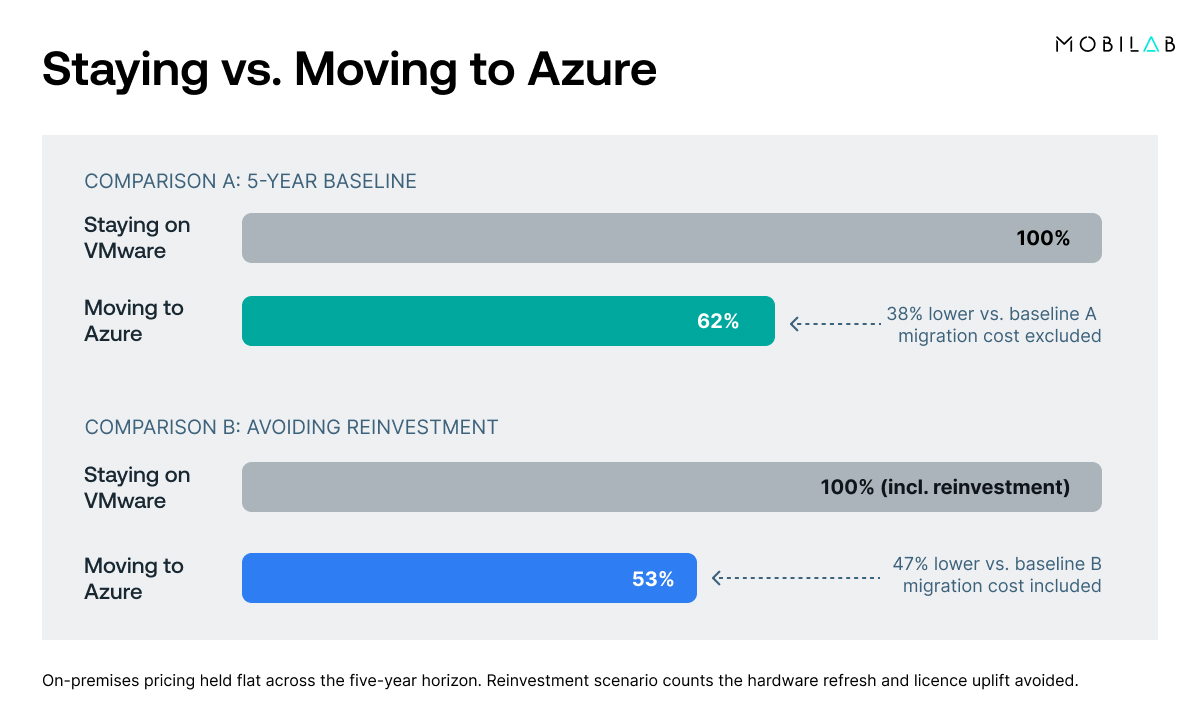
MobiLab turned that into a clear projection of both futures. Over five years, migrating to Azure costs 38% less than staying on VMware, with on-premises pricing held flat and migration cost excluded.
Counting in the hardware refresh and license uplift, the exit avoids, plus the one-time cost of migrating, the savings reach 47%.

Five-year cost 38% lower on Azure, a saving of over €8M, with on-premises pricing held flat across the horizon
Reinvestment scenario 47% lower, counting the hardware refresh and licensing uplift avoided, and the one-time migration cost incurred
€10M–€14M of on-premises reinvestment quantified before the renewal: hardware refresh plus a licensing uplift taking the contract from around €1M a year to over €3M
Several thousand servers across 30+ countries classified into five migration paths, with just under four in ten directly migratable
Azure foundation reviewed against 200 audit criteria across every target region
Migration wave start date derived from the constraints: the final quarter of 2026
⸻ STARTING POINT
A Refresh and a Renewal, Arriving a Year Apart
Two things add up to over €12M: a hardware refresh, and the price increase that comes with renewing VMware a year later, under Broadcom’s new pricing.
The hardware refresh runs to an estimated €5M–€7M — servers, storage and surrounding infrastructure, due the year before the renewal, on the cycle the company has always run.
The increase follows Broadcom’s acquisition of VMware, which ended perpetual licensing in favor of subscription bundles. The customer’s contract renews under that regime, and the price moves from around €1M a year today to over €3M at the multiples the market has seen since.
Both bills sit on the same estate: several thousand active servers on VMware Cloud Foundation, more than 30 countries, managed centrally, almost entirely virtualized.
The company needed two numbers for its board: what the staying costs are over five years, and what the moving to Azure costs are. It also needed one thing a cost comparison alone won’t supply — how much time it had left to act on the answer.
⸻ SETTING THE FOUNDATION
The Real Deadline Is the Wave Start
Migrating several thousand servers runs in waves, and the wave schedule is the real clock. Counting back from the renewal through planning, execution and the double-run period, the last viable start falls in the final quarter of 2026. Miss that window and the company buys the hardware and signs the renewal regardless of the decision. A business case delivered past that date describes a choice that has already been made.
So the team had to classify the estate before costing it, and cost it before the company committed to anything. The migration paths determine the Azure target, the target determines the cost, and the cost determines whether the waves are worth starting. Run those steps out of order and the numbers describe an estate that does not exist.
⸻ SOLUTION
Two Workstreams: the Cost Case and the Foundation
Before either future could be priced, every server needed a destination. MobiLab sorted the estate into five migration paths, separating what has to move as it is from what can shrink through consolidation or retirement, and from what should stay exactly where it is. Powered-off machines were left out of scope from the start.
Just under four in ten servers came out directly migratable. That population is the core of the exit and the basis of the Azure cost model.
- Rehost — the largest group, standard production workloads moving to Azure VMs as they are
- Replace — legacy services retired in favor of managed Azure equivalents
- Consolidate — underutilized servers merged, a substantial share of the estate
- Retain — workloads staying on-premises, mostly hardware-coupled or tied to local production
- Retire — servers switched off with nothing to replace
Rehost and replace make up the migratable share. Consolidate and retain account for most of the remainder in roughly equal parts.
A Five-Year Model, Priced Two Ways
MobiLab assessed the exit against staying on VMware in two ways. The first is a conservative baseline that keeps today’s on-premises prices flat and excludes the cost of migration. The second counts in the reinvestment the exit avoids.
On the baseline, using three-year Reserved Instances with right-sizing applied, Azure comes out 38% cheaper over five years than staying on VMware, a saving of over €8M. Holding on-premises pricing flat is a deliberate concession. It assumes the VMware renewal lands at today’s rate and the hardware refresh happens at today’s prices, both of which the market has moved past.
The second model adds in what the exit avoids paying. The on-premises side covers the hardware refresh and the licensing uplift; the Azure side accounts for about €1.5M in one-time migration costs. Counted that way, the saving reaches 47%.
The Foundation Review
MobiLab’s review tells the company what its landing zone carries today and what must be closed before waves begin, turning the cost case into a plan with a starting condition. The team assessed the customer’s existing Azure foundation against 200 audit criteria spanning identity, governance, networking, security, and operations, covering the hub the migration would land on.
⸻ CONCLUSION
A Repeatable Shape for Companies Facing a VMware Renewal
The shape holds for any company with a large VMware estate and a renewal under Broadcom pricing. Find the wave start date first, because it sits well before the renewal, and it governs everything else. Classify the estate before costing it. Hold the incumbent’s pricing flat so the comparison survives the challenge. Review the landing zone in parallel so the target is real. Then decide.
The renewal decision is also an opening. A company that has classified its estate, costed both futures and audited its landing zone has done the thinking a migration needs, and it has done it while it still has the option to act on it.
Decide before the deadline decides for you.
For any large VMware estate, the window to act closes before the renewal. Let’s price both futures while you still can.
Let's go forward. Together.
Every business is unique. Let us show you how we can accelerate your AI journey. Get in touch with us today!