


A Global Specialty Chemicals Company
Industry
Chemicals
Year
2026
Stack
Axium, Azure, Microsoft FastTrack
⸻ Business Impact
A Completed Palantir Foundry Exit: R&D Platform on Owned, Ontology Intact, Cost Base Reduced
For years, our customers' R&D ran on Palantir Foundry, a platform hosted and operated by the vendor, outside the company's own cloud tenant. The estate had grown to tens of thousands of applications and datasets, with no consolidated inventory anywhere. MobiLab migrated the workload with the ontology intact and the low-code, no-code experience on Axium, MobiLab's Semantic AI Platform.
Structured by a six-week assessment, this gave leadership a defensible plan and a stack proven on the customer’s own data.
R&D data and applications now sit in the customer’s own Azure tenant, in open formats, inside the company’s own IT governance, under agreements it already holds. Business users kept their way of working.
The users can now also describe an application and have AI build it on the shared ontology. Platform cost is split into components that the customer manages separately, rather than a single bundled figure.

Migration scope cut by 80% through owner-led, systematic, and evidence-based rationalization
Ontology preserved end-to-end, no loss of cross-workload reuse
Low-code, no-code application building on Axium, thousands of business users kept their way of working
R&D data on the infrastructure that the company owns and operates
Parallel platform stack retired, existing Azure, identity, and governance estate reused
Lower 5-year TCO, with every cost component priced against the market at renewal
⸻ STARTING POINT
R&D on Vendor-Operated Infrastructure, a Proprietary Ontology, and a Compounding Cost Base
Years of growth had made the customer’s Palantir Foundry estate enormous: tens of thousands of applications, a comparable number of datasets, hundreds of pipelines, and hundreds of connected source systems across different divisions, including ontology models linking instruments to results, custom benchmarking tools, and market intelligence pipelines.
For the IT department, that meant the company’s core R&D estate sat outside its own governance perimeter.
With the Palantir Foundry license approaching the end of its term, the company had to decide whether to renew or move. It chose to move and set three goals for the program.
⸻ SETTING THE FOUNDATION
Why the Ontology Had to Move Intact
Leaving Palantir Foundry is harder than moving a database, because three things have to come across:

The data: turning it into something usable takes the transformation logic that sits between the files, built up in Foundry pipelines over the years.

The applications: dashboards, reporting tools, and pipelines were built in Palantir Foundry’s own builders, with no neutral format to export into.

The ontology: the underlying ontology defines what an instrument, a sample, or a result actually means, and everything else is written against it.
None of the three was designed to travel.
The usual approach, moving the applications one at a time, rebuilding the shared definitions under each, would have led to redoing the same work a hundred times, missed the deadline, and destroyed years of accumulated reuse.
Why MobiLab Can Run a Palantir Foundry Exit
Experience with this specific migration. MobiLab has taken production estates off Palantir Foundry before. The team knows where these exits break: the ontology, the authorization model, and the applications built in tools with no neutral format to export into.
Axium handles the hardest step. Moving the ontology is what decides whether an exit lands inside a contract window. Axium’s AI-assisted import treats that as a product capability rather than as bespoke engineering.
The procedure is already settled. Six-week assessment, Proof of Technology on the customer’s own production data, ontology first, then division by division. It is the same sequence that carries the ontology-led migrations documented across our published case studies.
⸻ SOLUTION
Axium Holds the Meaning, Azure Holds the Data
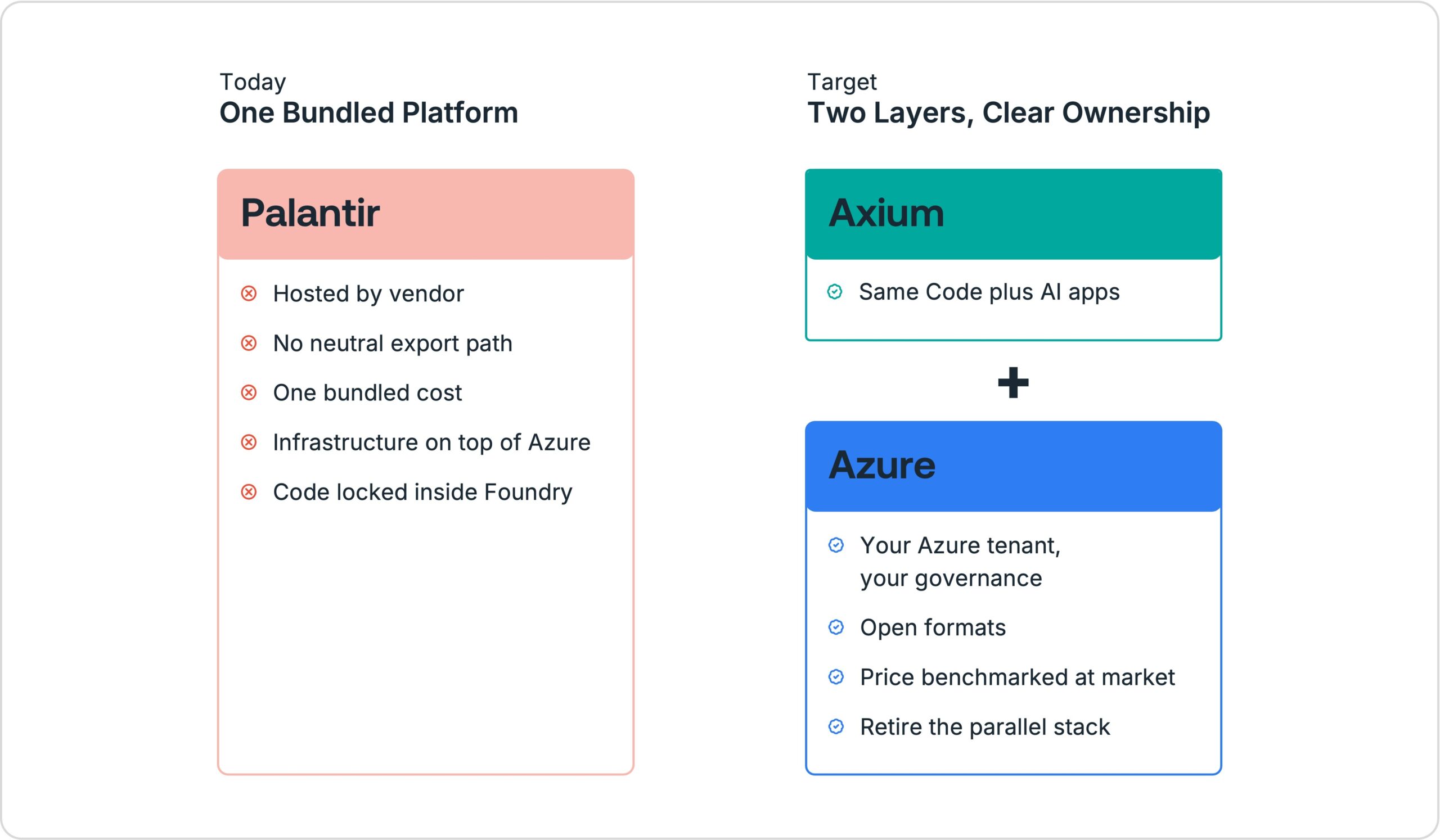
Palantir Foundry packaged everything together: storage, processing, the ontology, and the tools people used to build dashboards and applications. We split that into two layers, each with a clear owner:
Axium holds the meaning
the ontology itself, plus the applications and agent workflows built on it
A data foundation on Azure holds the data
unified storage and a governed catalog, running in the customer’s own tenant
Most R&D users now work only in Axium, querying and building on the ontology without ever seeing what sits underneath. Analysts and engineers who need the underlying tables go one level down into the data foundation. And because that foundation runs on Azure capacity the customer already holds, the existing estate carries the whole thing.
That separation is the real difference from a bundle: the data stays reachable by any tool the company already runs, and the layer on top can be changed without moving the data underneath it.
How the Exit Was Executed
Six Weeks from Open Question to Committed Migration Program
MobiLab built the case in a six-week assessment with the customer’s R&D, platform, and stakeholder leads.
Discovery
MobiLab ran interviews and workshops across the domains to build the company’s first complete inventory, then pruned it based on ontology dependencies and actual usage. Tens of thousands of applications were reduced to the few hundred that carried the business, grouped into roughly 100 workloads, over 95% of the original scope was cut before anything moved.
Design
The two-layer target, designed against the Azure footprint the customer already had.
Proof of Technology
A real Foundry application, rebuilt end-to-end on the target stack using production data.
Plan
A multi-quarter delivery plan and a ten-year TCO model.
Proof of Technology: Proven on the Customer’s Own Production Data
MobiLab took a representative application from the customer’s Palantir Foundry portfolio and rebuilt it end-to-end on the target stack — data, ontology, and user experience — so the decision rested on evidence rather than on a design.
Row-level security reproduced 1:1. We rebuilt the existing authorization model in the target governance layer, on production data. Analysts could see for themselves that the migration kept the boundaries they already relied on.
Ontology import accelerated. AI-assisted import turned the hardest step of the migration into a repeatable workflow. More than anything else, this decided whether the exit would fit the contract window.
All three kinds of users kept working without disruption. R&D has scientists who ask questions in plain language, analysts who build on a low-code canvas, and engineers who write code. The proof showed that each group was working on the same ontology, so each kept the way of working it already had.
Delivery: Application by Application
The program ran on six-week planning cycles, sprint reviews every two weeks, and quarterly business acceptance milestones, working through the divisions in the order set during discovery.
Customer involvement stayed structured rather than continuous: a small core team, one named owner per workstream, and MobiLab carrying day-to-day execution. Training ran per persona, scientist, analyst, engineer, and ontology owner, reaching operational fluency in days rather than weeks.
⸻ CONCLUSION
A Repeatable Exit Path for R&D Organizations Leaving Foundry
The shape holds for any R&D organization facing a Palantir Foundry exit: build the inventory the platform never gave you, let usage cut the estate down to what’s worth moving, prove one application end-to-end before committing, then scale. The architecture decisions last and the methodology repeats.
An exit is also an opening. The ontology was the hardest thing to move. It is also the reason the move was worth making. Every agent, copilot, and assistant the company builds from here reads the same definitions its scientists already trust, on infrastructure it owns, in formats it can take anywhere, with no supplier standing between the company and its own research. Owning it makes capacity growth compound.
Stop reinventing the wheel on every AI project.
Let’s build the foundation that gets your teams to production faster.
Let's go forward. Together.
Every business is unique. Let us show you how we can accelerate your AI journey. Get in touch with us today!