

A Global Chemicals Company
Industry
Chemicals
Year
2026
Stack
Axium, Databricks, Azure Data Lake, Unity Catalog, SQL, Knowledge Graphs
⸻ Business Impact
Faster, Lower-Cost Sustainability Reporting at Enterprise Scale
MobiLab enabled the customer transform fragmented sustainability data into a coherent, governed architecture powered by Axium.
After the transformation, the organization can deliver sustainability reporting significantly quicker and at a lower cost. Product Carbon Footprint (PCF) and Environmental Product Declaration (EPD) outputs are no longer built as bespoke initiatives but produced through standardized processes, reducing lead times and rework.
Development and maintenance costs dropped because sustainability use cases now reuse the same core building blocks instead of duplicating logic across teams and tools. New requirements, whether regulatory, customer-driven, or internal, can be implemented with minimal additional effort, rather than triggering new projects.
At the same time, reporting accuracy and consistency improved. Sustainability metrics are based on shared definitions and calculations, reducing discrepancies between regions and tools and increasing confidence in reported results.
Overall, the organization moved from slow, project-based sustainability reporting to a scalable operating model that supports faster product development, lower operational cost, and greater agility as sustainability requirements continue to evolve.
Key outcomes:

Faster delivery of ESG metric reporting
Lower development and maintenance costs
Improved accuracy and consistency of sustainability metrics
Greater agility to respond to new regulatory and customer requirements
⸻ STARTING POINT
A Reality Every Global Sustainability Team Faces
Over recent years, the organization invested heavily in sustainability and digital initiatives to meet regulatory requirements. As these solutions expanded, the sustainability landscape grew organically, increasing complexity across data flows, tools, and responsibilities.
This meant the previous solution could not deliver consistency and transparency. Data arrived in inconsistent cycles and formats, originated from multiple sources and followed different lifecycles. When we factor in different supplier inputs, it makes Product Carbon Footprint (PCF) and Environmental Product Declaration (EPD) reporting slow, complicated to scale, difficult to standardize, and often requiring manual reconciliation.
Responsibilities for key sustainability data products were distributed across the organization, making ownership unclear and dependencies between tools difficult to manage. This was exacerbated by a global operating model in which different regions used different systems and processes.
While modern data architecture principles had been introduced, they were not yet consistently applied in the sustainability domain. Reusable data products, defined service levels for data quality, and value-driven governance cycles were still missing, limiting the ability to scale sustainability use cases efficiently.
This led to three structural problems:
1. No single definition of core concepts
“Product,” “active BOM,” “emission factor,” and “activity data” all meant different things in different tools.
2. Repeated work and divergence
Similar calculations were rebuilt per tool. Changes in one place did not propagate elsewhere.
3. Weak governance
No clear ownership of data products, no SLAs/SLOs, incomplete lineage, and long lead times for EPD and regulatory reporting.
The Goal of the Project
The company needed a future-proof sustainability architecture that’s modular, transparent, and aligned across all use cases. Because regulations change, MobiLab’s solution should be able to integrate new use cases fast, while ensuring data quality through clear ownership and governance, providing a single source of truth.
⸻ SOLUTION
Axium as the Semantic Operating Layer for Sustainability
MobiLab’s core design move was straightforward: instead of fixing sustainability reporting system by system, we modeled the sustainability domain once at the semantic level and then bound everything else to it. We began with business reality, aligning terminologies and logics: what a “product” means in this company, how a Product Carbon Footprint (PCF) is derived, where emission factors originate, and which outputs matter across PCF, Environmental Product Declarations (EPD), Digital Product Passports (DPP), Use Phase emissions, and Responsible Chemistry.
We started with one of the terms, PCF, because it spans the entire lifecycle, from raw materials to end-of-life, and exposes every structural issue in one place. This made it the ideal starting point to validate the semantic model before expanding to the rest of the sustainability landscape.
From this pilot, we built the semantic foundation in Axium:
1. One Shared Language for Sustainability
It establishes one shared understanding of “Product,” “Raw Material,” “BOM,” “Emission Factor,” “PCF components,” and the outputs required for EPD, DPP, and other workflows.
2. A Live View of How Everything Connects
A live dependency graph across Databricks and other systems, generated without ingesting or duplicating data, showing how data products relate and which tools consume them.
3. A Reusable Structure for Sustainability Data
A consistent three-layer pattern: source-aligned data closest to the source system, intermediate layers capturing reusable logic like BOM explosion and emission aggregation, and consumer-aligned outputs for PCF, EPD, Use Phase, and regulatory reporting.
4. Governance That Works by Design
Ownership, lineage, service levels, and quality checks are encoded directly in Axium, turning governance into software rather than documentation.
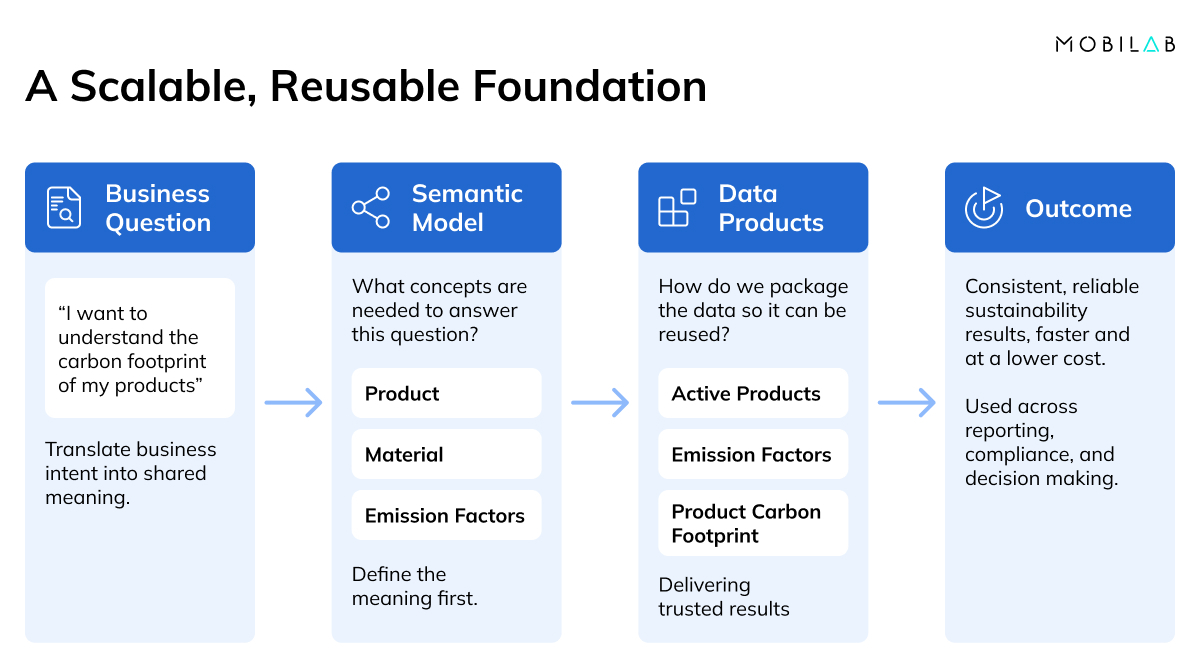
This semantic foundation was delivered through a three-phase program:
1. Pilot (PCF project)
Validate the semantic model, dependencies, and governance using the most cross-cutting sustainability use case.
2. Scale
Extend the architecture to EPD, DPP, Use Phase, and Responsible Chemistry, achieving 70–90% reuse from the PCF backbone.
3. Institutionalize
Embed ownership, SLAs/SLOs, automated lineage, and a sustainability data council to ensure long-term consistency and scalability.
The result is a semantic contract between sustainability, data, and IT enforced in software and a foundation that allows the entire sustainability landscape to operate as one coherent system.
⸻ Conclusion
Driving AI-Powered Sustainability Insights Across a Global Enterprise
The transformation established a scalable foundation for sustainability reporting that reduces cost, shortens delivery cycles, and improves confidence in results. Sustainability outputs are no longer built as isolated initiatives but assembled from shared, reusable components.
Governance moved from manual coordination to an operational model. Ownership, lineage, service levels, and data quality are defined once and applied consistently, enabling faster delivery without sacrificing control.
At a technical level, the organization now operates on a unified semantic model and a set of reusable data products designed to evolve with new regulations and future AI-driven use cases.
In summary, the transformation delivered:
➞ Faster and more cost-efficient sustainability reporting
➞ Reusable data products across core sustainability use cases
➞ Clear ownership, lineage, and quality controls
➞ A future-ready foundation for regulatory change and AI
Start small and scale.
Axium is designed future-proof, for all businesses to organize their knowledge and leverage the power of data and actionable business insights.
Let's go forward. Together.
Every business is unique. Let us show you how Axium can accelerate your data journey. Get in touch with us today!