

AI investment continues to grow across industries, but delivering value remains a challenge. A recent study by MIT found that 95% of companies reported no measurable return on their AI projects pointing to integration gaps and unclear alignment with how businesses operate. Axium, MobiLab’s Semantic AI platform, addresses this disconnect by reducing the friction between AI capabilities and enterprise workflows.
Instead of spending months preparing data or reengineering systems, Axium lets teams map out their processes, priorities, decision logics, and expert knowledge in a way AI can reference and reason with from day one. This lowers the barrier to experimentation, shortens the innovation cycle, and reduces dependence on IT support.
While most companies struggle to prepare their data for AI, Axium introduces a semantic layer built on ontologies to bridge that gap.
An ontology defines how concepts relate to one another. It acts as a shared map of how your business thinks and makes decisions. This modeling approach reduces the need for large-scale data preparation and lowers the investment required to deploy explainable, production-grade AI.
Key Capabilities of Axium's Semantic AI
- Seamless integration of structured and unstructured data from systems like SAP, PDFs, Word docs, decision trees, or process maps.
- Graphical translation and modeling layer that allows experts to input knowledge and define how data should be interpreted.
- Native Azure OpenAI, Microsoft Power BI, Azure Maps, and GitHub integration, available on the Azure Marketplace and as a Microsoft Fabric Workload.
- Built-in observability, governance, and flexibility to adapt to multiple business units.
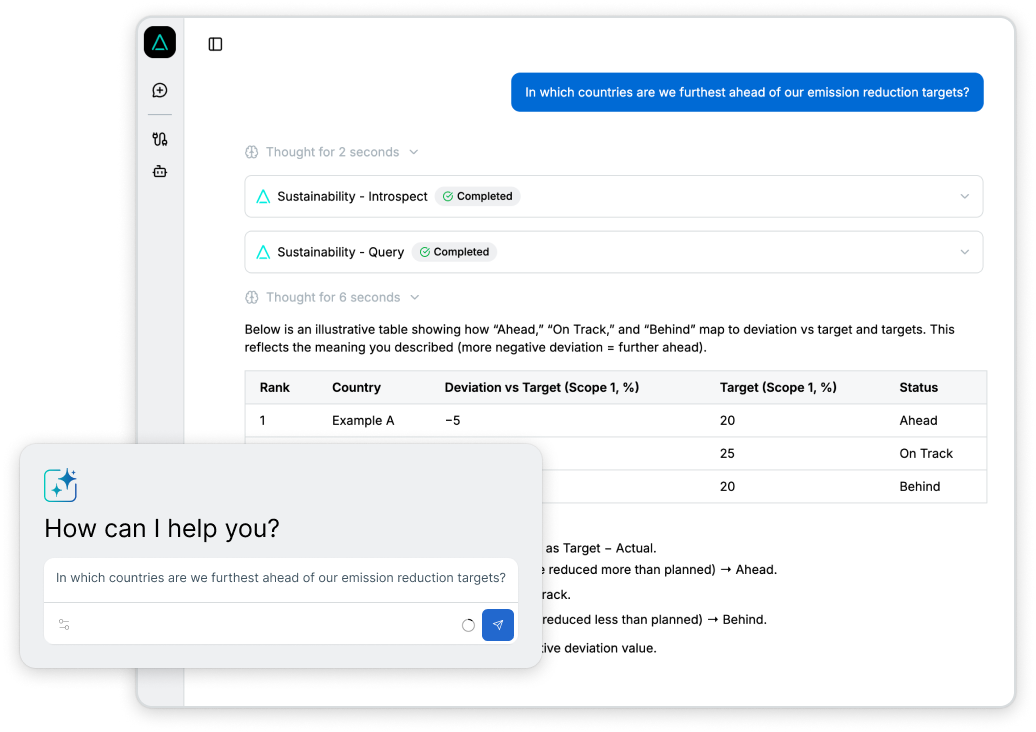
By modeling relationships, business logic, and expert knowledge Axium ensures that when users ask questions, trigger actions, or analyze trends, they’re interacting with data that’s not only accurate but also contextual, explainable, and aligned with how the business thinks and operates.
Imagine a sales leader trying to understand why certain deals were prioritized last quarter. A typical system might pull five fields from the CRM: customer size, margin, stage, forecast, and region, but still leave the reasoning unclear.
With Axium in place, the assistant links those numbers to actual business logic, like the company’s growth playbook, ESG focus, and vertical strategies. Instead of a vague snapshot, the AI explains the trade-offs behind the decision. It might say, “This deal was prioritized due to strategic fit, portfolio balance, and alignment with Q2 goals.” That is the difference Axium makes. It brings clarity and consistency to everyday decisions by using the knowledge your team already has.
Why Knowledge Matters
Without Axium (data-only approach):
A team tries to understand why a key deal was prioritized. The system pulls 5 data points: customer size, margin, sales stage, deal probability, and territory. The answer is incomplete. It’s unclear how trade-offs were made or why this deal mattered strategically.
With Axium (data + knowledge approach):
In the same case, Axium links structured CRM data with contextual business rules defined by experts (e.g., strategic vertical focus, market entry plans, customer history, ESG alignment).
Now, the AI assistant explains: “This deal was prioritized due to high strategic fit, P&L relevance, and alignment with Q2 portfolio goals as defined by your sales playbook.”
The answer is not just accurate, but explainable, auditable, reference-able and repeatable.
The Methodology Behind Axium
Step 1: Model with Ontologies
Use Axium’s ontology-driven modeling interface to define key business entities, relationships, and logic to reflect how your business thinks.
This allows knowledge experts to quickly structure how data should be interpreted without writing code. Ontologies serve as a semantic layer that helps align terminology, rules, and exceptions across domains or units.
Step 2: Bind with Data
Once your ontology is in place, Axium lets you connect it with your actual business data from structured systems like SAP and CRM to semi-structured sources like process maps or documents. Rather than transforming the entire dataset, Axium enables a targeted approach that links meaningful business concepts to relevant signals in your data, no matter where it lives.
Step 3: Enable AI-Ready Experiences
As soon as the model and data bindings are complete, you can immediately unlock powerful capabilities like Retrieval-Augmented Generation (RAG), intelligent search, AI-powered dashboards, and conversational assistants. Everything is backed by explainable logic, domain-aligned outputs, and enterprise-grade controls like role-based access and feedback loops.
Conclusion: From AI Experimentation to Enterprise Value
➞ GenAI will only deliver business value when it understands the logic, trade-offs, and semantics behind decisions.
➞ Axium enables this by giving enterprises the tooling to model their businesses, enrich it with domain logic, and serve it at scale, in Microsoft-native ecosystems.
➞ If you want to build meaningful, explainable AI applications that go beyond prototypes, Axium is the fastest way to start.
Axium is designed future-proof, for all businesses to organize their knowledge and leverage the power of data and actionable business insights. Request a demo if you would like to learn more.
Let's go forward. Together.
Every business is unique. Let us show you how Axium can accelerate your data journey. Get in touch with us today!